What every journalist should know about anonymous sources


Sherry Ricchiardi | August 02, 2016
During a workshop in South Sudan last year, reporters voiced concern that some media organizations were using anonymous sources to further personal agendas and attack political enemies.
There was a consensus that accurate, fair and reliable reporting was being undermined and that reader trust was at stake in the fledgling democracy steeped in political conflict.
Their ethical instincts rated a gold star.
Media professionals everywhere in the world grapple with the thorny issue of anonymity. It can be a double-edged sword.
According to the Society of Professional Journalists (SPJ), “Anonymous sources are sometimes the only key to unlocking a big story, throwing back the curtain on corruption, fulfilling the journalistic missions of watchdog on the government and informant to citizens. But sometimes, anonymous sources are the road to the ethical swamp.”
The SPJ code of ethics makes two important points on anonymity:
  • Identity sources whenever possible. The public is entitled to as much information as can be provided on sources’ reliability.
  • Always question sources’ motives before promising anonymity. Clarify conditions attached to any promise made in exchange for information. Keep promises.
The problem surfaced recently in The New York Times’ newsroom. In March, the newspaper’s top management cracked down on anonymity, sparked by readers’ complaints about “persistent” use of unnamed sources. The new guidelines require editors to approve the use of anonymity in stories.
“Direct quotes from anonymous sources should be used rarely, and only when such quotes are pivotal to the story,” according to the July 15 article explaining the crackdown. “At least one editor must know the specific identity of any anonymous source before publication.”
The tighter standards appear to be working. In July, Phil Corbett, the Times’ associate managing editor for standards, reported a “measurable drop,” around 30 percent, in anonymous sourcing.
Here are some resources that can help. The Online News Association (ONA) offers a Build Your Own Ethics Code tool that contains specific guidance for using anonymous sources. The process focuses on a series of questions:
  • What is the source’s reason for wanting not to be identified?
  • Is the information available elsewhere?
  • Do you trust the source?
  • Will the information come out soon anyhow?
  • Is the source eager or reluctant?
  • Is the source powerful or vulnerable?
  • Are the source and information worth going to jail for?
The module reminds us: “Before a journalist grants confidentiality, you should have a detailed discussion of the source’s reasons for wanting to avoid accountability, which is what happens when you don’t name sources. Tell the source that your stories are more credible and your sources more accountable when you use their names and gain a thorough understanding of the source’s motivation.”
When I meet with media managers, I suggest appointing a newsroom committee to develop or refresh guidelines for anonymous sources. I provide a packet of materials — case studies, exercises and handouts — that can help lead the way.
During workshops, I assign participants to provide a story from a newspaper, magazine or online posting that contains unnamed sources. We then work in small groups to decide whether the anonymity was justified using these guidelines:
  • Information from source must be important and absolutely vital to the story
  • It cannot be based on personal opinion
  • Information could not be obtained any other way
  • Source is highly reliable and in a position to know
When I use this exercise, I provide a handout created from NPR’s code on anonymous sourcing. This document is comprehensive, easy to digest and can be a model for newsrooms anywhere in the world where journalists are concerned with building trust and credibility.
Main image CC-licensed by Flickr via Thomas Leth-Olsen.

ONA offers conference fellowships [Worldwide]

The MJ Bear Fellowships identify and celebrate early-career digital journalists, working independently or for a company or organization, who have demonstrated — through professional experimentation, research or other projects — that they deserve support for their efforts and/or vision.

The fellows are up-and-coming journalists inside or outside the newsroom who are just beginning to make their voices heard in the industry and working to expand the boundaries of digital news.
Read about our what our fellows are working on.
Applications for 2016 are now openRead about the eligibility requirements and access theapplication form. The deadline to apply is 11:59 p.m. ET, July 14, 2016.
Each Fellowship provides:
  • Three online workshop sessions with a Personal Advisory Board.
  • Registration, travel and accommodations for the Online News Association Conference & Awards Banquet
  • Recognition at the ONA conference
  • ONA membership, with three years’ dues paid in full

12 tips for protecting newsrooms from cyberattacks


New digital newsrooms that rely almost entirely on the internet to work need to bulletproof not only their stories, but also their entire information system, including how information is stored, processed or exchanged via electronic means.
Technological attacks against websites, editorial servers and investigative journalists' personal accounts are on the rise. Governments, corrupt companies and criminal groups are trying to exploit any vulnerability of media organizations to obstruct independent investigations and, if possible, to destroy sensitive information. In some cases, a cyberattack is the first step in a chain of aggressions that might end with a serious or deadly physical attack. We have seen several such cases in Mexico, one of the most dangerous countries for independent journalists.
Since digital newsrooms are more and more involved in data mining and digital investigative reporting, they are attracting the attention of tech-savvy adversaries who can block investigations, delay publications or even destroy information before it is published.
Connectas Hub is one example of this trend. This investigative reporting platform in Latin America was coordinating the publication of several stories on abuse and corruption in the Mexican government when the website experienced a major distributed denial-of-service (DDoS) attack. Previously, Connectas detected attempts to infect their computers with a malicious virus after running a series about corruption in Nigaragua's customs agency and the construction of the Nicaragua Canal, a project backed by Chinese companies.
Connectas’ website went down for days until received protection from Deflect, a free service that helps independent media and other organizations protect themselves from DDoS attacks.
At that time, Connectas was one of the 100 newsrooms in 80 countries across the world that helped report on the Panama Papers, a leak of millions of files revealing the hidden finances of global elites.
There was no digital forensic investigation and Connectas was not able to confirm who was behind the attack. Still, the case highlights the need for newsrooms to improve their ability to face down large-scale cyberattacks.
Here are 12 tips that newsrooms can immediately apply to protect their digital systems.
1. Design an information security strategy. This means a newsroom should understand their adversaries, vulnerabilities, capacities and their own level of risk. You can use the Digital and Mobile Security for Journalists and Bloggers Manual I wrote as an ICFJ Knight Fellow (Spanish and Arabic, English version is coming) to help design your newsroom digital security strategy. You can also use this comprehensive list of tips to bulletproof a digital newsroom.
2. Get extra protection from DDoS attacks. I recommend applying for Deflect, which is managed by a Canadian organization led by Dmitri Vasiliev, a pioneer in digital security for human rights defenders. Newsrooms can also apply for a protection service offered by Google through the Project Shieldinitiative, which uses Google’s security infrastructure to protect news websites.
3. Hire someone who will attack your newsroom’s digital security system to look for vulnerabilities. This is known as a “pentester” in tech jargon. While there are a few pentesters who may work bono, you can also apply for help from the Information Safety and Capacity Project (ISC Project), a nonprofit based in Washington, D.C. Additionally, some private companies provide this service at a very low rate — try Pakal Security Labs in Guatemala.
4. Look into your website hosting company. It may already offer services that can help you monitor your newsroom and block any attacks.
5. Ensure your digital newsroom follows secure coding principles. Try using the Open Web Application Security Project’s (OWASP) list of web security risks as a guide.
6. Make sure that your IT department keeps the server software updated and patched. This will help protect all networked computers from virus infections.
7. If you are involved in a crowdsourcing project or use whistleblowers, make sure that your website has a SSL certificate to encrypt traffic. Media organizations can purchase SSL certificates at a very low cost from most hosting service providers.
8. Use the Salama app to evaluate risk for members of your newsroom. The app, which I created during my ICFJ Knight Fellowship, provides journalists with a guide to understand risks they are facing and customized advice for reducing them.
9. Make sure your organization meets basic information management security standards. One point of reference is the standards laid out by the Swiss-based International Organization for Standardization (ISO).
10. Make sure that reporters and editors use encryption systems and digital security tools while working on sensitive stories. You can use the Salama Library to access tips on how to bulletproof the editorial process.
11. You can also take a look at the digital security toolkit for investigative reporters I am curating with support from the ISC Project. This resource includes tools created and curated by the Guardian Project, the Electronic Frontier Foundation, Tactical Tech and other players.
12. Train both editorial and non-editorial employees to recognize social engineering and phishing attacks.
Main image CC-licensed by Flickr via Defence Images.

Journalists,endangered species in war zones - National Mirror, June 19, 2016

Journalists,endangered species in war zones  -  National Mirror, June 19, 2016

By Paul Omo Obadan

Amidst mounting prospect of global conflict posed by the threat of terrorism as depicted by Boko Haram,Al-Qaeda, ISIS and the likes, the rate at which members of the Fourth Estate of the Realm, otherwise described as the watchdogs of the society have increasingly had their ranks depleted by death through occupational hazards,particularly in crisis zones gives cause for concern. PAUL OMO OBADAN writes on this worrisome trend that calls for urgent attention and action of stakeholders.

In 1990, two senior and highly resourceful Nigerian journalists, Tayo Awotunsin and Krees Imodibie of the Champion and The Guardian newspapers respectively disappeared in Monrovia,Liberia’s capital, while on official assignment in the West African country then beset with a fratricidal war over the political control of the former American colony. Awotunsin was a member of the editorial board of the Champion newspaper, while Imodibie was the political editor of The Guardian, a national daily.

This incident way back in 1989,opened a floodgates of unprecedented wave of loss of life for journalistscovering conflict zones. Both the Nigerian Guild of Editors and the NigerianUnion of Journalists called on the government to seek vengeance against CharlesTaylor, a Liberian rebel leader fighting to oust Sgt. Samuel Doe, a despotichead of state, who had held his nation down with tyranny; and his partners incrime, responsible for the death of the two outstanding journalists.

Many accounts said the twojournalists were captured by troops loyal to Taylor in August while they werestaying at a downtown hotel. From there, witnesses said, they were moved toseveral locations. The first indication that their lives might be in dangercame in October when Taylor threatened to execute several hundred WestAfricans, including Nigerians, whom his troops were holding hostage. Taylormade the threat in an effort to force the withdrawal of the five-nation WestAfrican peace-keeping force, ECOMOG that entered Liberia in an effort toenforce a cease-fire in the war.

Taylor had vigorously opposed theintervention, arguing that the force was, in fact, trying to prop up thegovernment of President Samuel K. Doe, who was subsequently slain by anotherrebel group. In an account published in The Sunday Times, a Lagos weekly fromthe stable of Daily Times, the flagship of the Nigerian press, Mr. LindsayBarrett said the order to execute the two journalists were given by Putu Major,a rebel commander. Mr. Barrett cited unidentified witnesses who said that“although Charles Taylor did not give a direct order for their death, hisbitter denounciation of all West African nationals led directly to theexecution of the two Nigerians. The former Liberian President was accused ofstarving to death, Awotunsin and Imodibie in 1990.

This information was revealed tothe Truth and Reconciliation Commission (TRC) by a witness, Marie Vah, a nurseat the Minneapolis Hospital in the United States. She recounted how the twojournalists died in the hands of Mr Taylor’s defunct National Patriotic Frontof Liberia (NPFL) rebels under mysterious circumstances. “Captured and kept ina make-shift prison in the NPFL Gbanga headquarters in central Liberia, thejournalists looked like walking skeletons,” the TRC was told. Mrs Vah and afriend had travelled to Liberia from the US in 1990 in search of relatives onlyto be detained on the orders of the former rebel leader. Marie Vah is one ofseveral persons who testified at the Diaspora hearing at Hamline University inMinnesota. She said they were denied food during their brief imprisonmentalongside the journalist who “looked so emaciated.”

“The condition I saw them in, Idon’t think they survived long after we left the jail,” she said. TRC wasestablished by the Liberian government to heal the many wounds caused by theWest African country’s 14-year civil war. ‘I Never Ordered the Killing ofNigerian Journalists’ In an exclusive interview with the Chairman/ChiefExecutive Officer of Channels Television, Mr. John Momoh in Calabar, CrossRiver State while in exile in Nigeria in 2004, Mr. Taylor maintained hisinnocence, reiterating that he never ordered the killing of Nigerianjournalists.’ “Two Nigerian journalists were killed by a colonel of the thenNPFL, by the name ‘Putu Major’. Putu Major was arrested, he was courtmartialled, tried and executed for the killing of those two journalists. Idispatched my information Officer here to Nigeria to meet with the families ofthe two journalists, to explain the issue and offered them a small ‘envelope’,but they refused it.

“The killing of those journalistswere wrong, I did not accept it and I took action. Those two journalists thatwere killed caused the execution of Colonel Putu major. You go to Liberia nowand ask anyone, they will tell you Putu Major was executed by the NPFL under mycommand.” Taylor said.

As fate would have it, CharlesTaylor who ran to Nigeria on exile was subsequently arrested and taken to theHague to face judgment. A 50-year jail term was handed to the Liberianexpresident for encouraging rebels in Sierra Leone to mutilate, rape and murderduring the country’s civil war. He is the first head of state to be convictedof war crimes by an international court since the Nuremberg trials of Nazileaders after World War II. Since then, Journalists have been on the receivingend in conflict-riddled war zones.

The idiom, ‘The pen is mightierthan the sword,’ said to emphasize that thinking and writing have moreinfluence on people and events than the use of force or violence, has become afallacy. Now, action speaks louder than word and a sword can only change aperson’s opinion by force and then, often results only in the person’s death. So,when it comes to governance of the humans, violence outweighs our thoughts andthinking. This is best depicted by the way hundreds of journalists die in lineof duty, especially while covering conflicts.

The pen is no more, mightier thanthe sword, it would seem. ‘110 journalists killed this year need a responsethat matches the emergency’ According to Reporters without Borders (RSF), atotal of 110 journalists were killed around the world in 2015.

Noting that while many died inwar zones, the majority were killed in supposedly peaceful countries. 67journalists were killed in the line of duty this year, the watchdog group saidin its annual roundup, listing war-torn Iraq and Syria as most dangerous placesfor journalists with 11 and 10 fatalities respectively, followed by France,where eight journalists were killed in a jihadist assault on a satiricalmagazine. A further 43 journalists around the world died in circumstances thatwere unclear and 27 non-professional “citizen-journalists” and seven other mediaworkers were also killed, RSF said.

The high toll is “largelyattributable to deliberate violence against journalists” and demonstrates thefailure of initiatives to protect media personnel, the report said, calling forthe United Nations to take action. In particular, the report shed light on thegrowing role of “non-state groups” — often jihadists such as the Islamic Stategroup — in perpetrating atrocities against journalists. In 2014, it said,two-thirds of the journalists killed were in war zones. But in 2015, it was theexact opposite, with “two-thirds killed in countries ‘at peace’.” “Non-stategroups perpetrate targeted atrocities while too many governments do not complywith their obligations under international law,” RSF Secretary General, ChristopheDeloire said. “The 110 journalists killed this year need a response thatmatches the emergency. A special representative of the United Nationssecretary-general for the safety of journalists must be appointed withoutdelay.”

The 67 deaths bring to 787 thetotal number of journalists who were murdered, knowingly targeted or killed inthe course of their work since 2005, the Paris-based organisation said. In2014, there were 66 such fatalities. France was the scene of an unprecedentedattack on the press in January when gunmen opened fire at the offices of thesatirical magazine Charlie Hebdo, killing 12 people, including eightjournalists.

“It was an unprecedentedtragedy,” RSF said. “A western country had never suffered a massacre of thiskind in the past. “Charlie Hebdo’s journalists and employees have been livingunder close protection ever since. Some of them still have to keep changingtheir place of residence.” In Syria, the northern town of Aleppo was describedas “a minefield” for professional and citizen-journalists alike. “Caughtbetween the various parties to the conflict since 2011, journalists are liableto end up as collateral victims, being taken hostage by a non-state group (suchas Islamic State, the Al Nusra Front or the Free Syrian Army) or being arrestedby the Assad regime,” RSF said.

Those murdered in Syria includedJapanese freelance reporter Kenji Goto, whose execution by the Islamic Stategroup was unveiled in a macabre video in January. – India ‘deadliest’ Asiancountry – The RSF report also singled out India, where nine journalists hadbeen murdered since the start of 2015, some of them for reporting on organisedcrime and its links with politicians and others for covering illegal mining.India saw five journalists killed in the course of their work and four foruncertain reasons, which is why it ranked below France where the cause of deathwas known.

“Their deaths confirm India’sposition as Asia’s deadliest country for media personnel, ahead of bothPakistan and Afghanistan,” RSF said, urging the Indian government to establish“a national plan for protecting journalists”. In Bangladesh, four secularistbloggers were killed in acts claimed by local jihadists.

“The passivity of the Bangladeshiauthorities in the face of this bloodbath has fostered a climate of impunitythat is extremely dangerous for citizen journalists,” RSF said. The report alsoplaced the spotlight on 54 journalists who were held hostage at the end of2015, 26 of them in Syria, and 153 journalists who were in prison, 23 of themin China and 22 in Egypt. Judith Matloff teaches conflict reporting, and isresponsible for coverage of victims in conflict situations. She has pioneeredsafety training for journalists in Europe, Africa, Latin America and the UnitedStates.

To help foster a culture ofsafety in journalism, Judith Matloff, an adjunct faculty at the ColumbiaUniversity Graduate School of Journalism, hosted a day-long free securityworkshop on Conflict Reporting, and panel discussion at the Multi- Purpose Room,U.S. Consulate General, #2 Walter Carrington Crescent, Victoria Island, Lagos,Nigeria; to seek to remind the public of the rising dangers facing journalistsglobally.

Reporters increasingly findthemselves targeted by extremist groups and governments alike, leaving themvulnerable to those trying to keep corruption, abuse and other wrongdoings outof the spotlight These are the environment awaiting the next generation ofyoung correspondents. Judith, a conflict reporting instructor at ColumbiaUniversity, led the workshop for 23 young reporters from a diverse array ofbackgrounds.

The one-day introduction to riskassessment included practical advice on how to work safely onassignmennewspapers; Taiwo George, Cable; Joy Ken-Abakpoya, Nigeria TelevisionAuthority; Waheed Idowu, Nigeria Television Authority; Joseph Asa’ah, WFM 91.7;Richard Edoki, Rhythm FM; Paul Obadan, National Mirror; Mark Itsibor, TellMagazine; and Leke Baiyewu of the Punch. Others were Tokunboh Oyetunji, AfricaIndependent Television; Taiwo Ojedele, Voice of Nigeria; Moses Alao, NigerianTribune; Chiemelie Ezeobi, This Day; Nathaniel Akhigbe, BusinessDay; CharlesErukaa, Channels TV; Kehinde Adeaga, Rainbow FM; Ben Ezeamalu, Premium Times;Godfrey Obemeata, Galaxy TV; Emeka Monye, Silver- Bird TV; Adaugo Yulia Ozigbu,FRCN/Radio Nigeria; Thomas Uzuakpundu, Smooth FM; Tunde Pratt, RadioContinental and Precious Igbonwelundu of the Nation make.

The workshop led into a paneldiscussion and luncheon that brought together industry leaders working in andalongside the press. The Consul-General of the United States of America FrancisJohn Bray said in the opening remarks that conflict reporting had gainedattention due to the ever increasing internal and transnational conflicts thatwe see around the world.

‘In West Africa, we see terroristorganizations working together crossing borders to destabilize societies andgovernments. Boko Haram has been the source of mindless violence in Nigeria,Cameroon, Niger, and Chad. Violent extremists continue to fuel tension andviolence in Mali, Burkina Faso, Mauritania, the Central African Republic, Sudanand South Sudan.

So, given the magnitude of theseconflicts, you need to, as we say, ‘up your game.’ Effective reporting requiresdeep understanding of the nature of the conflict in order to report accuratelyand with compassion. You must master the competing narratives of thegovernment, the affected communities, including the victims, and thebelligerents. This mastery is critical for you to navigate in the fog andcontribute to resolution of conflict and peace building. Willie Brown, the 41stMayor of San Francisco, the first African American to hold that job said: “alie unanswered becomes truth within 24 hours.” It is your duty as aprofessional to prevent that from happening.”

“I’ve seen a lot of conflict in30 years of government service. Aside from almost four years in Nigeria, andthe obvious places like Iraq, Afghanistan, and Cote d’Ivoire, I’ve spent a lotof time in Bosnia, Somalia, and Haiti. And in all these venues, I’ve servedalongside some of the finest journalists in the world. In my personal opinion,what you face in Nigeria on any given day rivals the most complex situationsI’ve encountered anywhere.

Whether it is sectarian violencein Plateau, rising militancy in the Delta, festering pro-Biafra groups in theSouth- East, cult activities, or the insurgency in the North-East, there isconflict everyday. And this is why it is important for you and your peers toacquire knowledge and skills that will help you in conflict reporting. There isan old adage, often attributed to Aeschylus, the Greek playwright, that “inwar, truth is the first casualty.” In my experience, this is true. Moreover,democratic societies depend on the news media for this elusive thing we calltruth.

This dependence by the public onthe media gives you and your colleagues immense responsibility. On a dailybasis, without conflict, you make choices regarding the stories you report and theprominence you give to stories. Your readers and listeners depend on you toprovide them timely information on the political landscape in the country,government policies, the electoral process, foreign policies and internationaldevelopment to help them make informed decisions. The consequences ofinaccurate reporting can be harmful. You must strive to be accurate all thetime.

Your reporting on the armedconflict in the North-East, the serious violence in the Niger Delta, violenceduring elections and other conflicts are delicate situations that require youto not only be balanced, fair and accurate, but to also be sensitive in yourreporting to foster peaceful resolutions. Inaccurate, dramatic, and graphicconflict reporting can escalate violence and worsen a situation. The job istough. Soldiers in combat refer to a phenomenon that the Prussian strategistClausewitz identified as “the fog of war.” During conflict, journalists – anddiplomats – face the same fog as you seek truth.”

A panel of experienced young reporters gave some insight into their own experiences. Channels Television correspondent, Charles Erukaa talked about his experience covering the unrest of Boko haram, in the North-East, Nigeria. “Journalists were a huge target in Ferguson, they didn’t want us there,” Jarrett said. “What happens when the rioters start throwing things at journalists’ compounds? You weren’t even safe in the safe areas that they set up for you.” According to Dr. Tayo Popoola,lecturer in the department of Mass Communication, University of Lagos who has taught conflict reporting under the scope from 1914 when the first World War started, journalists have been involved in coverage of global conflicts.Professor Idowu Shobowale of Daily Times then was the first war correspondent.

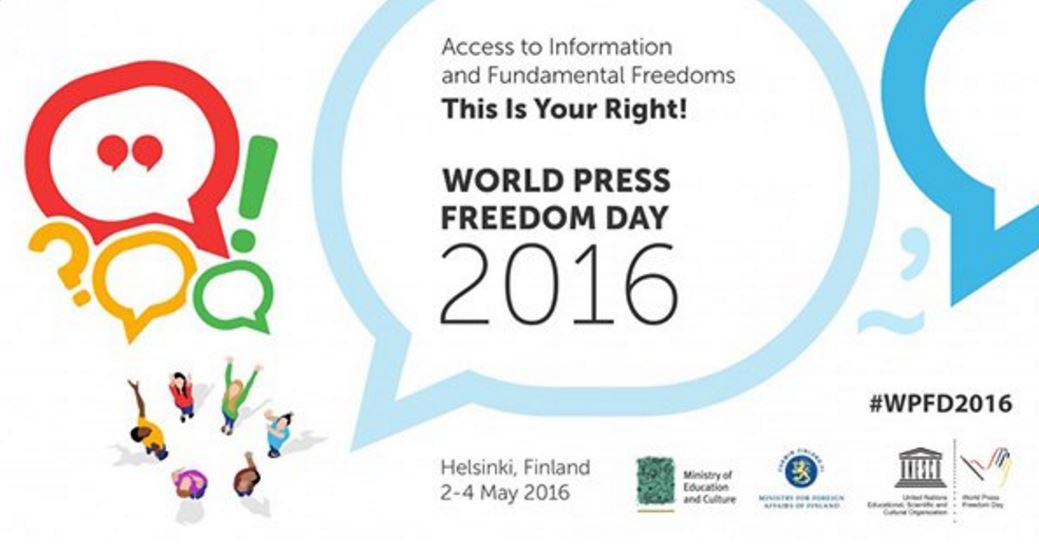
WPFD 2016 ENDS WITH FINLANDIA DECLARATION

Access to Information and Fundamental Freedoms - This Is Your Right!

World Press Freedom Day, 3 May 2016
Recalling that the right to information and to press freedom arenintegral parts of the freedom of expression, and are fundamental to democracy and to other rights and freedoms;

Noting the new United Nations (UN) 2030 Development Agenda, and in particular Sustainable Development Goal (SDG) 16 to promote just, peaceful and inclusive societies, which includes key points relevant to press freedom, access to information, safety of journalists and the
rule of law.

Further noting SDG target 16.10 which is to “ensure public access to information and protect fundamental freedoms, in accordance with national legislation and international agreements”, and recognising
this target as directly relevant to achieving all other SDG goals and in particular SDG 5 on gender equality;

Welcoming the increasing number of countries who enable the right to information in national law, including in their constitutions, while  also noting that legal guarantees for the right still do not exist, or  face significant implementation challenges, in a number of UNESCO’s Member States;

Underscoring that universal access to information and to knowledge is central to the UN’s World Summit on the Information Society (WSIS) process, which reaffirmed freedom of expression and universal access
to information as cornerstones for the ambition of achieving inclusive Knowledge Societies.

Recognising that the right to information and its effective implementation can be strongly supported by UNESCO’s concept of Internet Universality and the principles of Rights, Openness,
Accessibility and Multistakeholder participation;

Recalling that as per the 2005 UNESCO Convention on the Protection and Promotion of the Diversity of Cultural Expressions, artistic freedom and cultural diversity is closely intertwined with freedom of
expression, which incorporates the right to seek and receive information;

Further recalling the initiative of the African Platform on Access to Information and Freedom of Information Advocates Network recognition of the day in 2002 and UNESCO’s subsequent 2015 Resolution declaring
28 September as International Day for Universal Access to Information;

Recognizing the importance of acknowledging the role of women journalists and the specific threats they face, including sexualized violence and online and offline harassment


Emphasizing that the right to information encompasses access to information held by or on behalf of public authorities, or to which public authorities are entitled by law, as well as to access to information that is held by private bodies in regard to the exercise of public functions.

Understanding that the right to information is critical for informed decision-making, for the right to participation in the conduct of public affairs, for monitoring of public actions and reducing corruption, and for enhancing transparency and accountability;

Recalling the concern in the 2010 Tenth Anniversary Joint Declaration of the UN Special Rapporteurs on Freedom of Expression that historically disadvantaged groups continue to struggle to have their voices heard and to access information of relevance to them;

Recognizing that the right is also vital to developing a free, independent and pluralistic media and essential to strengthening its capacity to counter hate speech, promote intercultural understanding, and fight radicalization and violent extremism;

Acknowledging that violations of the right to press freedom also have an adverse impact on the right to information, including by the arbitrary blocking of access to online information, restricting
expression online, and arbitrarily intruding on digital privacy, as well as the killing, kidnapping, enforced disappearance, arbitrary detention, torture, deportations and other violations of journalists,
associated media personnel, trade unionists and human rights advocates.

Welcoming initiatives to promote safety of journalists such as the 5th February UNESCO conference on safety as well as the call for a Special Representative on Safety in the Office of the UN Secretary General,
and the International Declaration on the Protection of Journalists and the Global Safety Principles and Practices.

Call on each UNESCO Member State

To reaffirm that press freedom and to information are essential for a free, independent and pluralistic media, and crucial to the advancement of human rights and sustainable development;

To reaffirm a commitment to create a legal, policy and institutional environment which ensures that people can receive public information, including by means of a constitutional right to information as well as
through statutory and institutional mechanisms for implementation;

To ensure that exceptions to the right to information, including secrecy rules, are allowed only insofar as they adhere to such principles of international human rights laws as legality, a legitimate purpose and necessity, and to ensure that there is transparency around the operation of such limitations;

To put in place strong systems for proactive disclosure of information, taking full advantage of Information and Communication Technologies (ICTs) and promoting, as far as possible, universal
access to the Internet as well as open data principles;

To direct the necessary attention and political will to ensure full implementation of right to information, including by addressing the culture of secrecy within government institutions;

To ensure that legal frameworks are in place to protect the identity of confidential sources of journalism against direct and indirect exposure,and to enact legislation to protect whistleblowers;

To protect in law and in practice the right of individuals to protect the privacy of their digital communications by using encryption technology and tools that facilitate anonymity online;

To ensure that any bans on publication, including blocking of Internet content, are in fully line with international standards in this area which require legality, necessity, proportionality and legitimate
purpose, and to promote net neutrality and universal access to the Internet;

To enhance the information environment by putting in place positive measures to promote media diversity, including the availability of a broad range of cultural expressions through the media, and the
inclusion of minority groups in the media landscape;

To adopt and support gender equality policies and programmes in implementing the right to information, and also utilize the UNESCO Gender Sensitive Indicators for Media in advancing the right to press
freedom;

To put in place effective safety mechanisms to monitor, prevent, investigate and punish attacks against journalists and others exercising their right to freedom of expression, in line with the
universally applicable target of SDG 16,  and the framework of the UN Plan of Action on the Safety of Journalists and the Issue of Impunity.

To promote the right to information through Media and Information Literacy programmes to support people to develop their capabilities to use the Internet as informed creators and users of information and
knowledge;

To preserve independence of public service broadcasting as one of the essential pillars of pluralism and access to information;

To co-operate with other actors to ensure annual commemorations of the International Day for Universal Access to Information every 28 September.

Call on civil society, journalistic actors and internet intermediaries:

To raise awareness and build capacity among policy-makers, journalistic actors, citizens at large and vulnerable groups in particular, about the right to information as a fundamental human right and how it can serve democracy and sustainable development;

To contribute to the dissemination of good practices and experiences showcasing the direct link between the right to information, ethical standards, quality journalism, accountable governance, media self
regulation, participation, curbed corruption and sustainable development;

To promote and support investigative journalism, including using data tools, and to raise awareness about the value of journalism in the implementation of the right to information;

To promote the safety of newsrooms and journalists online and offline through training, ICT applications, safety protocols and systems, as well the importance of confidentiality of journalistic sources in the
digital age;

For Internet intermediaries, to strengthen transparency about data retention and access policies;

To advocate monitor the implementation of access to information laws,
policies and practices;

To use the International Day for Universal Access to Information (28 September) to promote the right to information, along with the values of transparency and accountability.

Call on UNESCO:

To promote awareness about the right to information as an important human right, necessary for the enjoyment of other human rights, and essential for transparent and accountable governance and sustainable
development;

To highlight that the right to information can only be effectively exercised and implemented on the basis of laws which regulate this right in accordance with international standards;

To call for a multi stakeholder consultation process with the Member States aimed at strengthening this right through a possible statutory instrument and an implementation mechanism, confirming that access to
public information has been recognized within the framework of the Universal Declaration of Human Rights and the International Covenant on Civil and Political Rights;

To contribute fully to the monitoring of the implementation of SDG 16.10, and to support innovative approaches to facilitate citizen involvement in this;

To report to the UN General Assembly on progress towards SDG 16 in the setting up, worldwide, of mechanisms to monitor, prevent, investigate and punish all attacks on journalism.

To continue highlighting the importance of the right to information for fostering universal, open, affordable and unfettered access to information and knowledge, and narrowing digital and knowledge
divides, including gender gaps;

To advocate for ICT policies guided by governance principles that ensure openness, internet access, transparency, accountability, multilingualism, inclusiveness, gender equality, net neutrality and civil participation including for youth, persons with disabilities, marginalized and vulnerable groups;

To promote the right to information through use of ICTs and open solutions for sustainable development and the understanding amongst cultures, fostering inclusion, tolerance and cooperation amongst societies;

To participate fully in celebrating the International Day for Universal Access to Information (28 September).


Open data movement bolsters press freedom across Africa

TOPIC: 


Stephen Abbott Pugh | May 03, 2016
The spread of mobile phones and connectivity across Africa offers opportunities and challenges for the way citizens discover and use information. If people have the skills and knowledge to harness them, open data and new technologies hold the keys to the media’s future.
Code for Africa is the continent’s largest network of civic technology and open data labs. We work with media partners to create actionable information for citizens that helps them in their daily lives. From checking if their doctor is dodgyto seeing if they are registered to vote, Code for Africa’s tools have been used in dozens of countries to help empower people.
How might technology be used in the coming years to further democratize the use of information and news across Africa? Our experts from Kenya and Nigeria set out their predictions:

Media freedoms in Kenya

by Catherine Gicheru, ICFJ Knight Fellow at Code for Kenya
Computers, the internet and mobile phones continue to change the way the world works, plays and communicates. In Kenya, there has been an exponential growth in ownership of mobile phones, reaching 88.1 percent penetration in September 2015. With 21.6 million internet subscriptions, about 74.2 percent of Kenyans now have access to internet services.
The advance of new media and technology has changed the way journalists work as well as how information is obtained and produced. The business of news is more of a dialogue between news providers and receivers of information. Citizens have much greater control over how and when they receive information. Audience involvement, either through cellphones or social media, has fostered a culture where more people value press freedom more broadly.
These technologies have also introduced new threats to media freedom. Mobile companies are obliged to give up cellphone records when ordered by the courts, presenting journalists with the challenge of keeping their sources secret. The Security Laws Amendment Act 2014 safeguards and widens the powers of police and undefined ‘national security organs’ to surveil and intercept communications, restricting media freedom. It also restricts citizens’ ability to point out and demand action on government failures. That is where whistleblowing platforms like Code for Africa’s AfriLEAKS come into play, as they provide citizens and journalists alike a platform where they can share information on stories and tips.
Digital technologies have provided journalists with opportunities to be innovative, ethical and inclusive, and to collaborate to solve problems and improve people’s lives. An example is GotToVote, which not only provides citizens with information on elections which was previously not easily accessible, but also gives journalists information that adds nuance and depth to their reporting. These tools will become even more crucial in the future, as not many journalists have the skills to analyze, synthesize and interpret the vast array of statistical information being made available on the internet.

Fighting for good healthcare in Nigeria

by Temi Adeoye, ICFJ Knight Fellow at Code for Nigeria
The desperate need for affordable healthcare in Nigeria’s poorly funded, understaffed health sector has driven many — especially the poor and vulnerable — into the hands of persons not qualified to treat them. Quacks. The impact of quackery is very difficult to measure, but nonetheless extremely severe. Its cost is measured in human terms — agonizing disillusionment, temporary or permanent deformation, complication of existing ailments and, in some cases, needless deaths.
Public medical institutions are not insulated from this cancer. The complicity and culpable negligence of recruiters at public health service commissions paves the way for quacks to infiltrate the system. It is a major headache for health regulatory authorities in Nigeria. The MDCN has over 40 cases against accused quacks in several courts across the country, but convictions are rare.
Code for Nigeria has therefore partnered with West Africa’s largest online news outfit, Sahara Reporters, to deploy a data-driven tool called Dodgy Doctors to empower citizens to fight quackery from the comfort of their computers and mobiles.
Dodgy Doctors is one of a set of tools in the SaharaHealth initiative that uses official MDCN data to help citizens quickly and easily check whether their doctor is properly registered. All they need to do is type a doctor’s name and the service cross-checks it with the MDCN’s master register.
Other apps in the suite include Hospital Finder and Medicine Prices. Hospital Finder is a geo-located service that helps citizens reduce the critical time it takes to locate health facilities around them. Medicine Prices helps citizens check how much the government expects them to pay for medicines.
Data-driven tools like SaharaHealth are changing how media affects our lives. It is no longer sufficient to talk about what is wrong in our world: the media should give citizens simple, actionable and easy-to-use tools to solve their own problems.
This article is an adaptation of a piece that originally appeared in the African Free Press, a Media Institute of Southern Africa project, published to mark the 25th anniversary of the adoption of the Windhoek Declaration. It was originally published at whk25.misa.org under a Creative Commons Attribution 4.0 International (CC BY 4.0) license and is republished on IJNet with permission.
Main image courtesy of African skyCAM.

CPJ panel explores intersections of gender and media freedom


Sam Berkhead | May 04, 2016
It’s no secret that journalists face more hindrances to their work than they have in decades. In the last year alone, press freedom has fallen nearly four percent worldwide.
The problem becomes even more acute when viewed through a gendered lens. Women journalists, in particular, are harassed, abused and attacked — both online and physically — as a means of silencing them and discouraging others from covering certain topics.
That was what happened to Khadija Ismayilova, an investigative reporter from Azerbaijan who reported on corruption within her country’s ruling establishment. After years of harassment, gender-related attacks and arrests, Ismayilova was sentenced to prison for alleged crimes widely viewed to be trumped up.
Ismayilova is one of the more high-profile examples of a journalist facing gender-related attacks in an attempt to silence her. Human rights attorney Amal Clooney counts her among her clients. But her case is indicative of a wider trend in which gender is increasingly wielded as a weapon against journalists everywhere. It’s a trend that goes far beyond internet comment boards.
A panel hosted by the Newseum Institute and the Committee to Protect Journalists (CPJ) discussed this trend and examined possible means of combatting it.
Molly McCluskey, a freelance foreign correspondent, explained that being aware of one’s surroundings and safety is a must, even while working in countries and locations that are often perceived to be safe for journalists.
“I think anywhere we go, there is always a potential for everything, even in places in the world that I thought I would be the most safe,” she said. “I have been surprised, when I've let my guard down a little bit, at some of the attention, reactions and threats that I've unexpectedly had to deal with.”
Step two? Understand that ending gender-based violence against journalists is a complex, intersectional issue that encompasses many cultures — and as such demands an equally varied solution, Courtney C. Radsch, CPJ's advocacy director, pointed out in the CPJ’s new book, “Attacks on the Press: Gender and Media Freedom Worldwide.”
"Efforts to combat and address online abuse and gender-based violence often emanate from the developed world and also tend to reflect conditions, cultural perceptions and expectations in developed countries," a study by the Best Practices Forum on Online Abuse and Gender-Based Violence Against Women and Girls at the 2015 Internet Governance Forum concluded.
And in an era when it's unrealistic to expect journalists to stay off social media, both law enforcement and the social platforms themselves have a responsibility to shut down online harassment, said Michelle Ferrier, a former journalist and founder of Trollbusters, an organization that provides women journalists with support when they're targeted by cyberharassment.
"This is really a much more insidious kind of activity than what we've seen in the past," said Ferrier. "So we need better laws that actually deal with the complexity of the kind of online activity that we're seeing with these smart mobs."
Nor is gender-based violence and abuse strictly a problem for women journalists, with LGBT journalists facing similar attacks. The CPJ book outlines the unique challenges faced by Katherine O’Donnell, a transgender journalist in Scotland, as well as transgender journalists in less-tolerant Uganda. Even men aren’t immune to gender-based harassment. As a result, efforts to combat gender-based attacks against journalists must keep all genders in mind.
Ultimately, the CPJ’s panel discussion and book bring a mere fraction of voices and experiences into the discussion surrounding harassment and violence toward women journalists. It’s something Joel Simon, CPJ executive director, highlighted in his introduction.
“Clearly, vital voices are being suppressed and, as a result, some of the information we need to make sense of a complex world is missing,” he wrote.
As more journalists — of all genders and cultures — come forward with their stories, the stigmas surrounding gender-based violence will continue to fade, Simon wrote, bringing more representation to the table.
And while talking openly about the problem won’t necessarily solve it, doing so is a vital first step in breaking the so-called “code of silence,” said Lara Logan, a 60 Minutes correspondent, at the panel.
“It wasn't hard for me to speak out about [my assault],” she said. “I think what is harder for victims of sexual violence, rape and sexual assault is that people like to bury it very quickly and they want you to show it. ... I've had young journalists from Egypt and other places come and see me for things that happened to them, and you realize that the first step is not having to carry that burden on your own.”

Social innovation fellowship accepting applications [Worldwide]


Journalists who have developed business endeavors that address social needs are encouraged to apply for this fellowship in Chicago.
In partnership with Chicago Ideas Week, the Bluhm/Helfand Social Innovation Fellowship will grant visionary leaders with community support, exposure to successful business leaders and a US$10,000 financial contribution for their business endeavor.
The fellowship was established by two philanthropists and entrepreneurs, Leslie Bluhm and David Helfand, who wish to help the next social innovators and entrepreneurs confront social needs.
The winning recipients will be hosted in Chicago during Chicago Ideas Week on Oct. 17 to 23, with all expenses paid.  
Applicants must be 35 years old or younger and working as for-profit or nonprofit social entrepreneurs.
The application deadline is June 7.
For more information, click here.stellanwofiaupdates

Eight worldwide journalism opportunities to apply for in May


stellanwofiaupdates

Looking to expand your journalism toolkit, take on a new beat or receive recognition for your work? Check out these promising courses, fellowships and competitions with deadlines in May. Each is open to journalists worldwide.
Journalists ages 22 to 38 around the globe can apply for Moment Magazine’s Daniel Pearl fellowship, which encourages the production of in-depth stories about deeply ingrained prejudices. In addition to US$5,000 in project funding, fellows also receive mentoring from established, prestigious journalists like Wolf Blitzer, Linda Feldmann, Martin Fletcher and more. For more information, click stellanwofiaupdates
Thomson Reuters Foundation “Tomorrow’s News” newsroom training Deadline: May 2, 2016
The Thomson Reuters Foundation is offering “Tomorrow’s News,” a free, in-house newsroom training, to media outlets in developing countries or countries in political transition. The program includes workshops on strategizing and producing cross-platform content, as well as ongoing guidance and support and updates on the latest knowledge on media trends and convergence. For more information, click stellanwofiaupdates
 University of Westminster graduate scholarships Deadline: May 3, 2016
Students and journalists wishing to advance their studies can apply for full and partial graduate scholarships from the University of Westminster. Full scholarships cover tuition fees, accommodation, living expenses and flights to and from London. Prospective students can choose from a variety of programs, including the Media, Arts and Design Scholarship. For more information, click stellanwofiaupdates
Casa Pública Residencies Program Deadline: May 12, 2016
Foreign reporters working at an independent media outlet outside Brazil can apply for a BRL7,000 (US$2,000) grant and accommodations in Rio de Janeiro to cover the 2016 Olympic Games. As part ofAgência Pública’s Casa Pública residency program, journalists will closely examine the human rights impact of the World Cup and Olympics in Brazil. For more information, click stellanwofiaupdates

The Woods Hole Oceanographic Institution in Woods Hole, Massachusetts is seeking writers, producers and editors for its marine science fellowship. Fellows will gain knowledge of oceanography and ocean engineering through seminars, laboratory visits and field expeditions. A travel allowance and room and board will be provided. For more information, click stellanwofiaupdates
Fund for Investigative Journalism grants Deadline: May 16, 2016
The Fund for Investigative Journalism is offering grants to support investigative reporting projects around the world. The average award is US$5,000 and should be put toward project-related expenses.Recent grants have helped fund investigations on abusive labor brokers in Thailand, an American abroad who refused to be an FBI informant and the burning of trees as a renewable energy source in Canada. For more information, click stellanwofiaupdates
CUNY business journalism fellowship Deadline: May 31, 2016
The McGraw Center for Business Journalism at the City University of New York's Graduate School of Journalism is offering fellowships to journalists worldwide with five or more years of experience. Fellows will receive grants of US$5,000 a month for one to three months to produce longform print or radio pieces. For more information, click stellanwofiaupdates
Thomson Reuters Foundation Kurt Schork Awards Deadline: May 31, 2016
Each year, the Kurt Schork Awards in International Journalism honor freelancers and local journalists in developing and transitioning countries whose work would otherwise go unrecognized. Stories can cover conflict, human rights, cross-border issues and similar hot-button issues. Each winner receives a US$5,000 prize at a ceremony in London. For more information, click stellanwofiaupdates
Main image CC-licensed by Flickr via sigmama.